

How to Evaluate Speculative Decoding Before Production Rollout
Speculative decoding is worth testing when the target model already meets quality requirements and token generation speed is the measured bottleneck. The adoption decision should be based on production traces: acceptance rate, inter-token latency, p95 response time, memory pressure, serving compatibility, and regression behavior on real prompts.
The earlier article Speculative Decoding, Quantization, and Distillation Tradeoffs compared three optimization paths. This companion goes deeper on one question engineering leaders ask after that first comparison: how do you evaluate speculative decoding before putting it in the default serving path?
The short answer is measurement. Speculative decoding changes the decoding process, not the model's training objective. A smaller proposer drafts several possible next tokens, and the target model verifies them in parallel. The original ICML paper reported 2x to 3x acceleration with identical outputs in T5-XXL experiments. That result explains why the method is attractive. It does not tell a CTO whether the method fits a private enterprise assistant, a RAG-heavy document workflow, or an agentic workflow with tool calls.
This evaluation is a production-readiness question. Southeast Asian enterprises do not need the fastest demo. They need lower latency, stable cost, auditable behavior, and a rollback path that operations teams can own.
What speculative decoding in production systems is
Speculative decoding is an inference-time technique for reducing autoregressive generation latency. Standard decoding asks the target model for one token, appends that token to the context, then repeats the same sequence until the answer is complete. The process is serial, which makes long answers and multi-step reasoning feel slow even when the GPU has unused compute capacity.
Speculative decoding adds a faster proposer. The proposer drafts several candidate tokens. The target model verifies those candidates in one forward pass, accepts the longest valid prefix, and resumes from the first rejected token. Hugging Face's assisted decoding guide describes the same pattern as using a helper to propose candidates while the main model verifies them in one pass, so expensive target-model passes are reduced when the helper is accurate.
The production promise is narrow and useful: when the target model remains in the verification loop, the team can improve generation speed while preserving the target model's behavior under supported algorithms. vLLM describes its speculative decoding path as designed to reduce inter-token latency under medium-to-low QPS, memory-bound workloads. That phrase matters because it names the adoption boundary.
The method is also broader than one draft-model pattern. vLLM lists draft models, n-gram proposal, suffix decoding, MTP, EAGLE, and other proposer modes in its current speculative decoding configuration. NVIDIA TensorRT-LLM also supports multiple speculative decoding techniques, including draft target, Medusa, EAGLE, and lookahead decoding in its Llama 3.3 70B optimization work.
When speculative decoding is worth evaluating
Speculative decoding deserves an evaluation when five conditions are true.
• The target model already passes the quality bar. The optimization should reduce latency, not compensate for a weak model choice.
• The workload produces enough output tokens for acceptance to matter. A 30-token answer leaves little room for multi-token acceptance to compound.
• The serving path is memory-bound or underutilized. If the bottleneck is already compute saturation, a proposer can add overhead.
• Traffic is interactive or medium-to-low QPS. vLLM's documented fit is not high-concurrency batch serving.
• A compatible proposer exists. Same-tokenizer assistant models are simpler; cross-vocabulary approaches add translation and sampling constraints.
This is why the method fits internal assistants, analyst copilots, Enterprise RAG answers, document review summaries, and agentic workflows where users wait for long generated responses. It is less compelling for short classification, extraction already handled by structured models, or workflows dominated by retrieval, OCR, database calls, and tool latency.
A practical decision gate is simple: if token generation is less than half of end-to-end response time, speculative decoding is rarely the first optimization to ship. The team should fix retrieval latency, caching, prompt size, tool orchestration, or batching before adding a second model path.
Which measurements to assist adoption decision
The evaluation should start from production traces, not synthetic prompts. The traces need real system prompts, real retrieval payloads, real tool outputs, realistic answer lengths, and the failure examples that caused previous release reviews to slow down.
Seven measurements decide the adoption case.
1. Time to first token. Speculative decoding usually affects generation after the initial context is processed; a slow first token points to prompt length, prefill, retrieval, or cold-start behavior.
2. Inter-token latency. This is the cleanest signal. Speculative decoding should reduce the wait between visible tokens.
3. Full response latency at p50, p95, and p99. The p95 view catches variance that average token speed hides.
4. Acceptance rate. A high draft acceptance rate means the proposer predicts useful continuations. Low acceptance turns the proposer into overhead.
5. Accepted tokens per target pass. The business value comes from reducing target-model forward passes, not from adding another component.
6. GPU memory and utilization. The draft path consumes memory, scheduling attention, and operational headroom.
7. Quality equivalence on the enterprise task. The release gate should compare groundedness, refusal behavior, extraction fidelity, policy compliance, and citation correctness.
NVIDIA reported speculative decoding speedups of up to 3.55x for selected Llama 3.3 70B target-and-draft configurations on HGX H200 systems, measured on December 11, 2024. That number is useful as a ceiling reference, not as a budget assumption. Your acceptance rate, sequence length, concurrency, and serving stack set the actual result.
How the benchmark should be designed
A credible benchmark compares the current serving path against speculative configurations under the same traffic pattern. The benchmark should run in the target environment or a faithful staging environment with the same GPU class, same inference framework, same prompt templates, and same observability hooks.
A good benchmark matrix includes four axes: output length buckets, concurrency levels, proposer type, and speculation depth. For example, test short, medium, and long answers; single-user and burst traffic; draft-model, n-gram, and framework-native proposer modes; then sweep the number of speculative tokens. The purpose is to find the stable operating region, not the best single screenshot.
Dynamic lookahead deserves its own comparison. Hugging Face reported that dynamic speculation became the default assisted-generation mode in Transformers 4.45.0 and showed speedups up to 2.7x depending on task. The lesson for enterprise teams is operational: fixed speculation length is easy to reason about, but dynamic control often handles prompt variability better.
Cross-vocabulary assistant models also need a separate gate. Hugging Face's Universal Assisted Generation work extended assisted generation across model families and reported 1.5x to 2.0x acceleration in benchmark settings. vLLM now documents heterogeneous-vocabulary draft support with constraints, including greedy draft sampling for that path. That gives teams more pairing options, but it also adds tokenizer translation and implementation-specific restrictions to the release checklist.
Where speculative decoding fails in evaluation
Speculative decoding fails when the proposer is cheap but wrong. The target model rejects too many drafted tokens, and the system pays the cost of both models without reducing enough target passes. This usually appears as decent p50 performance with disappointing p95 latency, memory pressure, or higher operational variance.
It also fails when the benchmark excludes the actual enterprise workload. A clean chat benchmark does not represent a RAG answer with 12 retrieved chunks, a policy-bound refusal, Bahasa Indonesia domain phrasing, and a tool-generated table. The proposer can accept generic continuation patterns while struggling on proper nouns, document citations, local regulatory language, code-like identifiers, and structured output.
Serving-stack compatibility is the third failure mode. vLLM's current documentation lists method-specific configuration keys and known support boundaries. TensorRT-LLM's documented gains depend on model pair, GPU platform, quantization path, and runtime setup. A method that works in a notebook still needs release work: model packaging, autoscaling profile, telemetry, rollback, and incident playbooks.
The final failure mode is combined optimization. Quantizing the target model, changing sampling temperature, adding speculative decoding, and changing batch scheduler settings in one release hides the cause of any regression. Evaluate each change alone first, then test the combined configuration under production-like load.
What the practical adoption checklist is
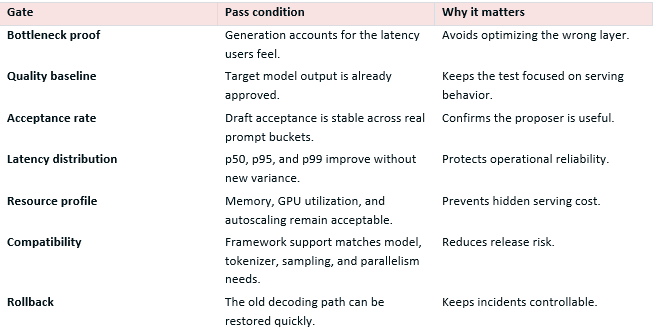
Use this release checklist before adopting speculative decoding in production.
FAQ
Is speculative decoding safe for enterprise AI systems?
Yes, when the target model remains in the verification loop and the serving framework supports the selected algorithm. Safety still depends on evaluation. The release gate must test groundedness, refusal behavior, policy compliance, and latency variance on real enterprise prompts.
Does speculative decoding always preserve output quality?
The original algorithm preserves the target distribution under its assumptions. Production systems still need checks for framework behavior, hardware numerics, sampling settings, tokenizer compatibility, and prompt-specific regressions. Treat quality equivalence as a measured release criterion.
What acceptance rate is good enough?
There is no universal threshold. The right acceptance rate is the one that reduces target-model passes enough to improve p95 latency after draft overhead, memory use, and concurrency are included. Measure accepted tokens per target pass alongside acceptance percentage.
Should speculative decoding be tested before quantization?
Start with the bottleneck. Test speculative decoding first when users wait for generated tokens from an already-approved model. Test quantization first when memory footprint, placement, or cost per request blocks deployment. Test combined settings only after each method passes alone.
Can speculative decoding help RAG and agentic workflows?
Yes, when generation time dominates the response. RAG and agentic workflows often include retrieval, tool calls, permission checks, and orchestration latency. Measure the full trace first. If tool latency dominates, speculative decoding improves only the visible tail of the workflow.
What should a CTO ask the engineering team before approval?
Ask for a benchmark using production traces, a comparison against the current serving path, p95 and p99 latency, acceptance-rate distributions by prompt type, memory impact, quality-regression results, framework compatibility notes, and a rollback plan.


