
Speculative Decoding, Quantization, and Distillation Tradeoffs
What the three optimization paths are
Enterprise AI teams usually meet the same wall after a model works in testing: the experience is too slow, the serving bill is too high, or the model is too broad for the workflow. Speculative decoding, quantization, and distillation all improve deployment economics, but they move different parts of the system.
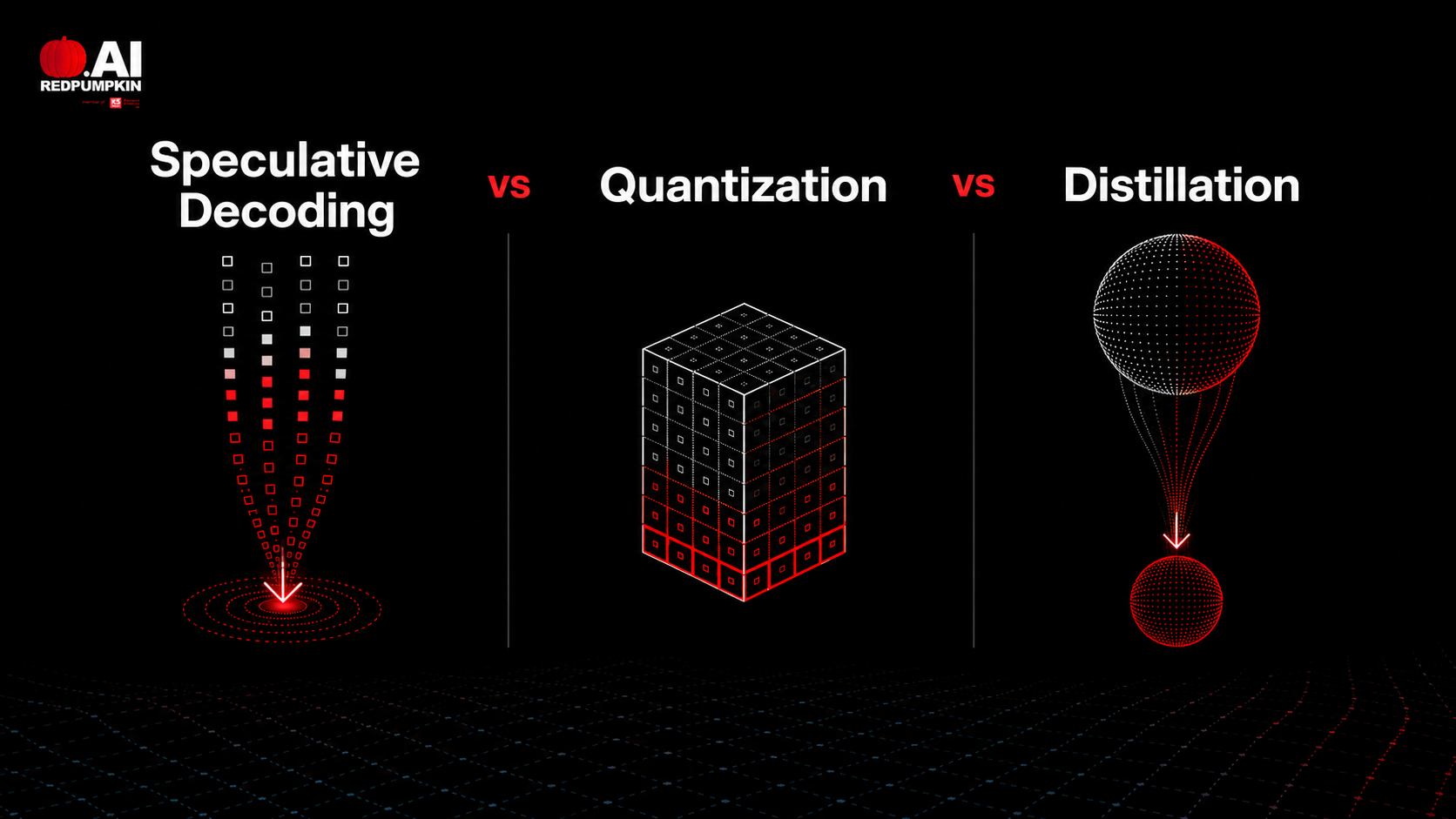
Speculative decoding changes the decoding process. A smaller draft model proposes several next tokens, then the larger target model verifies those candidates in parallel. The original ICML paper reported 2x to 3x acceleration with identical outputs in T5-XXL experiments, because the target model can validate multiple candidate tokens in one forward pass instead of generating every token serially.
Quantization changes numerical representation. Instead of storing and computing with full-precision weights and activations, the model uses lower-bit formats such as FP8, INT8, or INT4. vLLM describes quantization as a precision tradeoff that creates a smaller memory footprint and allows larger models to run on a wider range of devices.
Distillation changes the model itself. A smaller student model is trained to imitate a larger teacher model, often on a defined task or domain. The classic knowledge distillation paper framed the method as compressing knowledge from a larger model or ensemble into a single model that is easier to deploy.
When speculative decoding is appropriate
Speculative decoding is the strongest candidate when the target model already meets quality requirements and the production pain is response speed. The CTO keeps the larger model in the verification loop, so the optimization targets generation latency rather than model behavior.
Pros
• It preserves the target model's output distribution under the original algorithm, with practical caveats for hardware numerics and implementation details. vLLM documents its speculative decoding path as algorithmically lossless for supported modes.
• It directly addresses inter-token latency. vLLM positions speculative decoding for medium-to-low QPS, memory-bound workloads, which is common in internal assistants, analyst tools, document workflows, and agentic enterprise AI systems with long responses.
• It produces measurable throughput gains when draft acceptance is high. NVIDIA reported speculative decoding speedups above 3x in TensorRT-LLM internal measurements for selected Llama target-and-draft configurations on H200 systems measured in November 2024.
Cons
• It adds a second model or proposal mechanism to the serving path. Teams must monitor draft acceptance rate, latency variance, memory pressure, and failure modes.
• The speedup is workload-dependent. Short answers, high traffic concurrency, compute-bound serving, or a poor draft model reduce the benefit.
• Serving-stack compatibility matters. vLLM documents feature incompatibilities and version-specific support boundaries for speculative decoding, including limits around some parallelism configurations in current documentation.
When quantization is right
Quantization is the natural first option when the constraint is GPU memory, cost per request, or model placement. It helps a team fit a larger model on available hardware, increase batch size, or reduce serving spend without changing application logic.
Pros
• It directly reduces memory pressure. SmoothQuant reported up to 1.56x speedup and 2x memory reduction for tested LLMs while preserving accuracy in its experimental settings.
• It is broadly supported in serving stacks. Hugging Face Text Generation Inference supports GPTQ, AWQ, bitsandbytes, EETQ, Marlin, EXL2, and FP8 quantization paths depending on the use case.
• It gives infrastructure teams more placement options. vLLM lists hardware compatibility across AWQ, GPTQ, FP8, INT8, BitsAndBytes, GGUF, and other implementations, which makes hardware fit a first-class design criterion rather than an afterthought.
Cons
• Quality regression is task-specific. Lower precision can affect reasoning, code generation, extraction accuracy, long-context retrieval, and domain language in ways that generic benchmarks miss.
• Calibration and format choice create release work. AWQ and GPTQ-style flows often depend on calibration or pre-quantized checkpoints, while on-the-fly methods trade simplicity against performance.
• Hardware support changes the answer. A method that looks attractive in a notebook can be a poor production choice if the target GPUs, CPUs, or inference framework do not support it efficiently.
When distillation is correct
Distillation is the strategic option when the enterprise workload is stable enough to justify a smaller specialized model. It is less of an inference switch and more of a model product decision: the team creates a new artifact, validates it, governs it, and owns its drift.
Pros
• It can reduce serving dependency on a large general model. A smaller student model can be tuned for a repeated workflow, such as classification, extraction, routing, summarization, or policy-bound response generation.
• It can improve task efficiency when the training signal is strong. Google's Distilling Step-by-Step work reported that a 770M T5 model outperformed a 540B PaLM model on one benchmark task by using rationales as additional supervision.
• It gives architecture teams more control. The smaller model can be evaluated, versioned, deployed, and monitored around a narrower contract than a general assistant model.
Cons
• It requires a training pipeline, dataset strategy, and evaluation harness. The work moves from serving optimization into model development and governance.
• Specialization narrows behavior. Research on specializing smaller language models for multi-step reasoning found that gains on the target task came with tradeoffs against broader generic ability across tasks.
• Teacher errors transfer. If the larger model produces biased, brittle, or policy-inconsistent examples, the student model learns those patterns unless the dataset is filtered and tested.
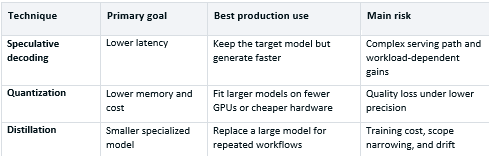
How do the tradeoffs compare?
What should enterprise teams test before choosing?
The decision should be made with production traces, not intuition. The most useful evaluation set includes real prompts, real retrieval payloads, real tool outputs, real concurrency, and the failure examples that matter to the business.
• Latency: time to first token, inter-token latency, and full response latency.
• Throughput: tokens per second under realistic concurrency and burst patterns.
• Cost: GPU memory, GPU count, utilization, batching behavior, and autoscaling profile.
• Quality: task accuracy, groundedness, extraction fidelity, refusal behavior, and reasoning depth.
• Reliability: variance across prompts, long-context behavior, rollback path, and monitoring signals.
• Operations: deployment process, versioning, compatibility, observability, and incident response.
What is the practical decision framework?
1. Choose speculative decoding when the current model is good enough and user experience is limited by token generation speed.
2. Choose quantization when the model is too expensive or too large for the target serving environment.
3. Choose distillation when the task is stable enough to justify training and operating a smaller purpose-built model.
4. Combine techniques only after each one is measured separately, because precision changes, draft acceptance, and task-specific quality interact in ways that hide regressions.
FAQ
Is speculative decoding better than quantization?
Speculative decoding and quantization solve different problems. Speculative decoding targets latency while preserving target-model behavior. Quantization targets memory and cost by reducing numerical precision. A CTO chooses between them by identifying the current bottleneck, then validating the result against production traces.
Does quantization always reduce accuracy?
Quantization does not always create visible quality loss, but every enterprise workload needs evaluation. Lower-bit formats increase regression risk for reasoning, code, long-context retrieval, and domain-specific tasks. The release gate should compare full-precision and quantized outputs on the tasks users actually run.
Is distillation cheaper than serving a large model?
Distillation can reduce serving cost after training, but it adds upfront work: data creation, training, evaluation, governance, and maintenance. It becomes attractive when the workflow is stable, high-volume, and narrow enough for a smaller model to own the task reliably.
Can these methods be combined?
Yes. A team can quantize a target model, use speculative decoding for generation, and distill narrow workflows. The safest operating pattern is to benchmark each method alone, then test combined configurations under production-like traffic before changing the default serving path.
Which method should an enterprise AI team test first?
Start with the bottleneck. If users wait too long for tokens, test speculative decoding. If infrastructure cost or memory blocks deployment, test quantization. If the same narrow task runs repeatedly, test distillation. The fastest pilot is rarely the best production answer unless it improves the measured constraint.


