

Why Your AI Strategy Needs to Stop Thinking in Single File
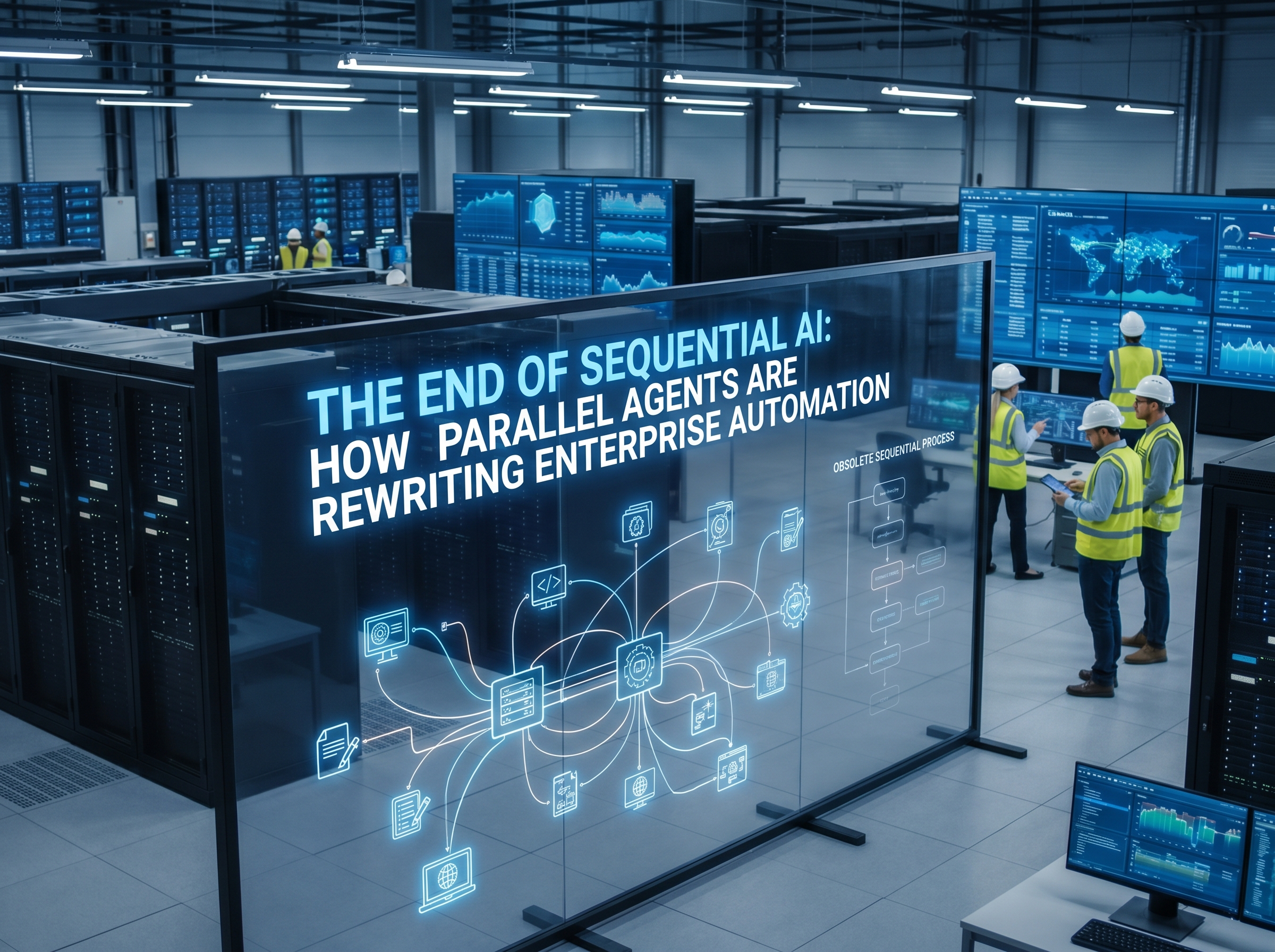
A customer writes in with a billing dispute that also involves a delayed shipment, a promo code that was never applied, and a request to change their delivery address. In a sequential AI setup, this query enters a single processing chain. The billing agent works the dispute. When it finishes, the logistics agent checks the shipment. Then the promotions agent validates the code. Then the address update runs. Four independent problems, handled one at a time, in a queue that the customer never asked for.
The customer waits. The SLA clock ticks. And the fourth issue, the address change, is the one that actually matters most, because the shipment is already in transit. By the time the sequential chain reaches it, the delivery window has closed.
This is not a hypothetical. This is what sequential AI looks like under real operational load. And in 2026, it is the architecture that most enterprises are still running.
From chains to parallel orchestration: what changed
Sequential AI, where a single agent or a rigid chain of agents processes tasks in order, was the dominant pattern for the first wave of enterprise AI automation. It worked well enough when queries were simple and volume was low. One input, one reasoning path, one output.
The problem emerged at scale. According to research from MindStudio, a task that should take 30 seconds ends up taking 3 minutes in a sequential pipeline because multiple agents are waiting in line todo independent work. Each step waits for the previous one to complete, even when the steps have no dependency on each other. The bottleneck is structural, not computational.
What changed is that the complexity of enterprise tasks outgrew what a single-agent context window can handle effectively. A customer query that contains four intents is four tasks that happen to arrive in the same message. A trade finance verification that involves document extraction, regulatory cross-checking, anomaly scoring, and exception reporting is a set of parallel workstreams that converge at a decision point.
The architecture shifted accordingly. Gartner predicts that 40% of enterprise applications will feature task-specific AI agents by the end of 2026, up from less than 5% in 2025. The move is from monolithic agent chains to coordinated teams of specialised agents working in parallel, each scoped to a narrow function, each operating within its own context.
Three forces accelerated this shift. First, foundation models became reliable enough to serve as components rather than standalone systems. Second, orchestration frameworks matured to the point where coordinating multiple agents became an engineering problem rather than a research problem. Third, enterprises discovered that individual agent tasks moved faster while end-to-end operations rarely kept pace. Which means, the bottleneck had moved from model capability to workflow architecture.
What orchestration actually means in practice
Orchestration is the coordination layer that decides which agents run, when they run, and how their outputs converge into a single result. Without orchestration, parallel agents are just multiple independent systems that happen to be running at the same time, and independent multi-agent systems without coordination amplify errors by 17.2x, according to research on multi-agent reliability. With a centralised orchestrator, that amplification drops to 4.4x.
The architecture is straightforward. An orchestrator agent receives an inbound task, decomposes it into sub-tasks, assigns each sub-task to a specialised agent, and manages the fan-out and fan-in of results. The orchestrator enforces dependencies (Agent B cannot start until Agent A delivers its output), handles failures (if Agent C times out, retry or escalate), and assembles the final response from the converging outputs.
Five orchestration patterns dominate enterprise deployments in 2026: sequential chains (still useful for strictly dependent tasks), parallel fan-out/fan-in(for independent sub-tasks), hierarchical manager-worker trees, handoff routing(for intent-based dispatch), and iterative loops with evaluation gates.
The pattern that matters most for enterprises moving from pilot to production is the combination of parallel fan-out with handoff routing, where the orchestrator classifies the inbound request, dispatches independent sub-tasks to specialised agents running in parallel, and routes edge cases to human reviewers based on confidence thresholds.
How this works: customer query and service routing
Consider the billing-plus-shipment-plus-promo-plus-address query from the opening. In a parallel orchestration architecture, the flow works differently.
The orchestrator receives the inbound message and runs intent classification to identify all intents present. It detects four: billing dispute, shipment status, promo code validation, and address change. It assesses priority: the address change is time-sensitive because the shipment is in transit.
Four specialised agents launch in parallel. The billing agent pulls transaction history and begins dispute analysis. The logistics agent queries the carrier API for real-time shipment status. The promotions agent validates the code against the order record. The address agent checks whether the shipment is still interceptable and initiates the update.
The orchestrator does not wait for all four to finish before acting. The address agent's output e.g. "shipment interceptable, address updated", is routed to the customer first, because the orchestrator knows this is the time-critical resolution. The billing dispute resolution follows. The shipment status and promo validation results arrive last, assembled into a single consolidated response.
Total elapsed time: the duration of the longest single agent task, not the sum of all four. The queue bottleneck disappears because there is no queue. Each agent operates independently, the orchestrator manages convergence, and the customer receives a prioritised resolution instead of a first-in-first-out sequence.
This is the pattern that companies like Typewise are deploying in production for enterprise customer service, using specialised agents for intent detection, knowledge retrieval, response drafting, and escalation are all coordinated by an AI supervisor that routes, prioritises, and resolves.
The maturity curve: where enterprises actually sit
The data on enterprise readiness tells a clear story about the gap between intention and execution.
According to the 2026 Gartner CIO and Technology Executive Survey, only 17% of organisations have deployed AI agents to production. Yet more than 60% expect to do so within the next two years. The agentic AI market reached approximately USD 7.8 billion in 2025 and is projected to exceed USD 10.9 billion in 2026. The money is moving. The deployments are not keeping pace.
AgentMarketCap's 2026 Enterprise Agent Deployment Maturity Model puts it more bluntly: 86% of companies are stuck in what they call "pilot purgatory", where proofs of concept works in controlled environments but never reach production scale.
The maturity curve looks roughly like this. At the bottom, enterprises are running single-agent automations on isolated tasks e.g. a chatbot here, a document classifier there. In the middle, they have experimented with multi-agent pipelines but are still running them sequentially, with brittle handoffs and no centralised orchestration. At the top, where fewer than 15% of enterprises currently sit, parallel agent orchestration is in production, with observability, governance, human-in-the-loop controls, and the ability to add new agents without re-architecting the pipeline.
The gap between the middle and the top is not a technology gap. It is a design and operations gap. The models are capable. The frameworks exist. What is missing is the architecture that connects specialised agents to enterprise data, enforces governance, and scales without accumulating invisible failure modes.
What separates working deployments from failed ones
Over 40% of agentic AI projects are at risk of cancellation by 2027, according to Gartner, with unclear value, rising costs, and weak governance as the primary drivers. The failure patterns are consistent enough to be instructive.
The first pattern is scope creep disguised as ambition. Successful deployments start with agents scoped to a single, well-defined task. Scope expansion happens only after the narrow version proves stable for 90 or more days. Enterprises that launch with broad, multi-function agents (the "do everything" agent) discover that probabilistic systems do not generalise gracefully. A narrow agent that routes billing disputes reliably is more valuable in production than a broad agent that handles billing, logistics, and HR but fails unpredictably on edge cases.
The second pattern is deploying without observability. Research from Digital Applied found that 84% of CIOs lack a formal process for tracking AI accuracy in production. Without comprehensive observability, cost overruns accumulate invisibly, accuracy degradation goes undetected, and security anomalies are missed. The orchestrator is only as trustworthy as the monitoring around it. If you cannot see what each agent decided, why it decided it, and how confident it was, you do not have a production system, you have a pilot running on trust.
The third pattern is treating orchestration as a technical project rather than an operational one. The five gaps that account for 89% of scaling failures are integration complexity with legacy systems, inconsistent output quality at volume, absence of monitoring tooling, unclear organisational ownership, and insufficient domain training data. Three of those five are operational, not technical. The enterprises that succeed are the ones that assign clear ownership, define escalation paths, and build feedback loops between the agents and the teams that depend on them.
What this means for your AI strategy
If your current AI architecture processes tasks in sequence, and those tasks do not actually depend on each other, you are paying a latency tax on every transaction. The fix is a different architecture: parallel orchestration with specialised agents scoped to each sub-task.
The shift from sequential to parallel orchestration is a structural change in how enterprise AI systems are designed, governed, and operated. The enterprises that move first will move faster while also ready to handle task complexity that sequential architectures cannot reach at any speed.
The question is whether your current setup is architected for where enterprise AI is heading, or still thinking in single file.
FAQ
What is the difference between sequential and parallel AI agent orchestration?
Sequential orchestration processes tasks one after another in a chain, where each agent waits for the previous one to finish before starting. Parallel orchestration decomposes a complex task into independent sub-tasks and assigns them to specialised agents that run simultaneously, with an orchestrator managing convergence. The practical difference is latency: parallel orchestration completes in the time of the longest single sub-task, while sequential orchestration takes the sum of all sub-tasks.
Why are most enterprise AI deployments still running sequential architectures?
Most enterprises began their AI automation with single-agent systems or simple chains, which were sufficient for early use cases. Transitioning to parallel orchestration requires changes to workflow design, governance frameworks, and monitoring infrastructure instead of just model upgrades. According to Gartner, only 17% of organisations have deployed AI agents to production as of 2026, and the majority of those are still running sequential patterns.
What are the main risks of parallel AI agent orchestration?
The primary risk is error amplification. Research shows that independent multi-agent systems without centralised coordination amplify errors by 17.2x. Proper orchestration with a centralised coordinator reduces this to 4.4x. Other risks include governance gaps (68% of organisations cite governance as the primary barrier to scaling) and the operational complexity of monitoring multiple agents running simultaneously.
How does parallel agent orchestration improve customer service resolution times?
In customer service, a single inbound query often contains multiple intents. Parallel orchestration allows each intent to be handled by a specialised agent simultaneously, with the orchestrator prioritising time-sensitive resolutions. The result is faster resolution without queue bottlenecks, because the system processes all intents concurrently rather than sequentially.
What should enterprises prioritise when moving from sequential to parallel AI orchestration?
Start narrow: deploy parallel orchestration on a single, well-defined workflow where the sub-tasks are clearly independent. Build observability from day one: monitor what each agent decides, why, and at what confidence level. Assign clear organisational ownership for the orchestration layer. Expand scope only after the narrow deployment proves stable for at least 90 days.
About Redpumpkin.ai
Redpumpkin.AI exists for AI projects where the hard part is to make AI work reliably inside complex enterprise environments. We help organisations choose, build, and operate the right AI architecture across commercial and open-weight models, multiple cloud environments, and demanding business workflows. Our strength lies in structured evaluation, deep engineering, and production deployment, turning AI ambition into systems that are accurate, governed, scalable, and ready for real work.


