

Flexibility vs. Reliability in Agent Orchestration: The Trade-Off Every AI Builder Must Face
The Question Most Teams Are Asking Wrong
When teams set out to build production AI agents, the conversation almost always gravitates toward the same set of concerns: which model is most capable, how much context it can hold, how many tools it can access, and how fast it can respond. These are reasonable things to care about. But they are also the easier problems because the model vendor is solving them for you.
The harder problem is one that no model release will fully resolve, and it lives entirely within the decisions your team makes. It is the question of how much freedom the agent should actually have.
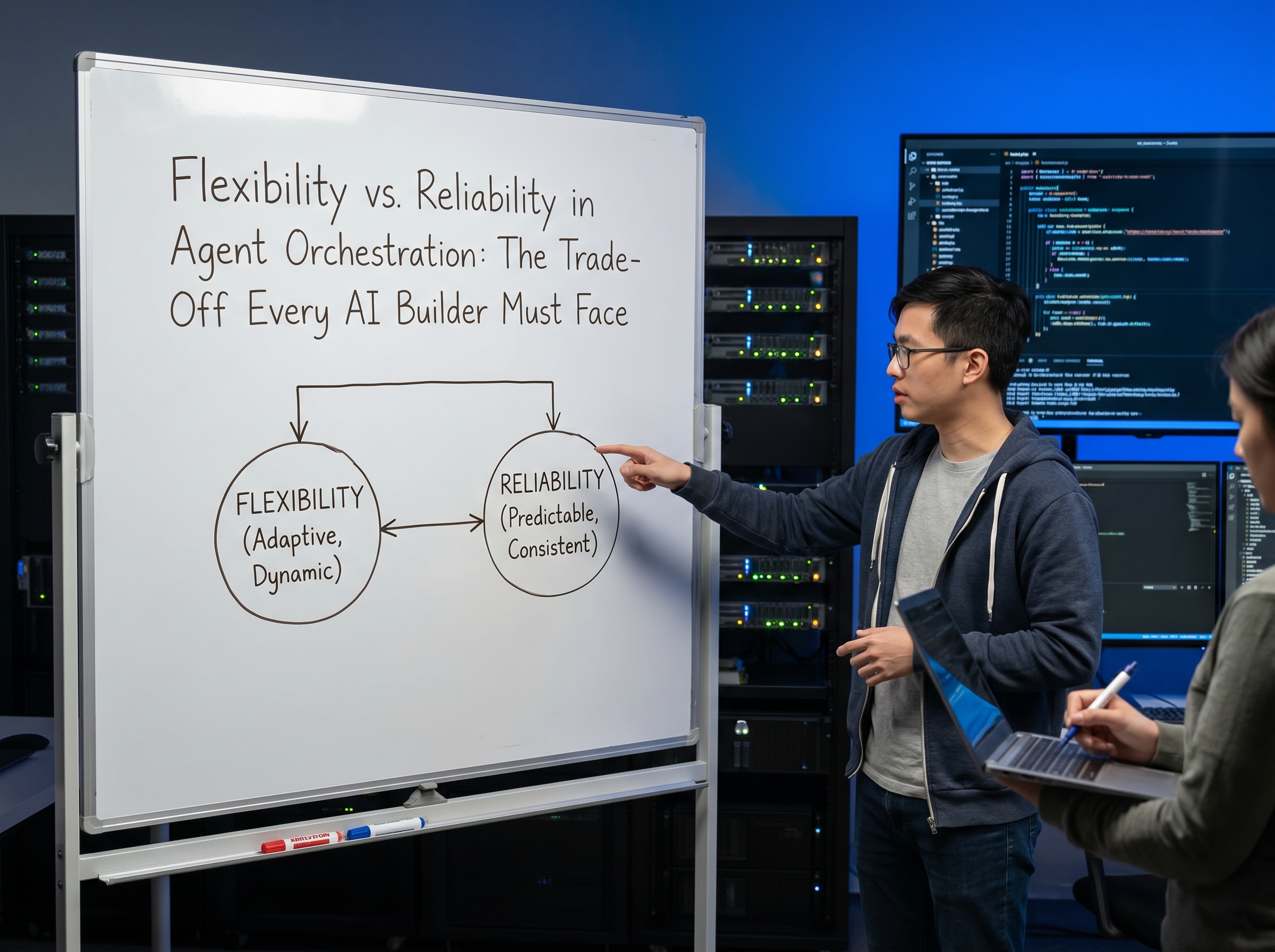
This is the central trade-off in agent orchestration: the tension between building a system that is flexible enough to handle the messy, open-ended nature of real user needs, and one that is reliable enough to be trusted with consequential actions in a production environment. Both goals are legitimate. Both can produce powerful systems. But they pull in opposite directions, and the teams that build the most durable agent products are the ones that understand precisely where that tension lives, and make deliberate choices about how to navigate it.
What Agent Orchestration Actually Is
Before exploring the trade-off, it is worth being precise about what orchestration means, because the word gets used loosely.
Agent orchestration is the system design layer that sits between a user's intent and the agent's actions. A language model may generate the reasoning: it may decide that a certain tool should be called, that certain information needs to be retrieved, that a particular step comes before another, but orchestration is what determines how that reasoning becomes actual behavior in the world.
Consider a simple-sounding request: a user asks an agent to book a dentist appointment for this Friday at 8 AM. On the surface, this is a two-minute task. But the orchestration layer must resolve a surprisingly large number of questions before a single action is taken. Whose timezone does "8 AM" refer to, the user's or the service provider's? Does "this Friday" mean the upcoming Friday in the user's local date, or is the conversation happening close to midnight in a different timezone where Friday has already begun? Should the agent check the user's existing calendar before attempting to book, and if so, what constitutes a conflict that would block the action? Should the agent make the booking directly, or should it present a draft for the user to approve? If Friday at 8 AM is unavailable, does the agent have the authority to suggest and book an alternative time on its own, or should it return control to the user?
None of these are questions the language model alone can definitively answer. They are product decisions, architecture decisions, and in some cases safety decisions. The orchestration layer is where the agent's raw capability gets shaped into a specific, real-world behavior, and the design of that layer determines whether the agent is trustworthy or unpredictable, useful or dangerous.
The Two Ends of the Design Spectrum
Most agent architectures occupy a position somewhere on a spectrum between two philosophical extremes, and understanding both ends makes it easier to reason about the space in between.
On one end sits the flexible, freeform agent. This kind of system is built around the premise that the language model is capable enough to figure things out, that if given broad access to tools, context, and a well-crafted prompt, it can decompose complex requests, infer what the user actually wants, navigate ambiguity, and produce a useful outcome even when the workflow was never explicitly defined. Flexible agents tend to have wide tool access, few hard-coded decision points, and a general expectation that the model's own judgment will carry most of the weight. They are often impressive in demonstrations, and for good reason: they genuinely can handle a remarkable range of situations.
On the other end sits the structured, opinionated agent. This kind of system treats the agent as a participant in a controlled workflow rather than a freeform actor. Work is represented through explicit objects e.g. tasks with typed fields, events with timestamps, state machines with defined transitions, tool permissions that must be satisfied before execution, confirmation gates that prevent certain actions from being taken without review. The model still does meaningful reasoning, but that reasoning is channeled through a system that knows, in advance, what kinds of actions are possible and what conditions must hold before they can happen.
The flexible approach maximizes scope. The structured approach maximizes control. The tension between them is not a problem to be eliminated, it is a design reality to be managed.
Why Flexible Agents Fail in Production
The appeal of flexible orchestration is easy to understand. It works well for open-ended requests, novel workflows, and situations where the full range of edge cases is too large to encode in advance. It improves naturally as the underlying model improves. It can handle the kind of multi-step, multi-tool, cross-domain requests that make agent demos genuinely exciting. And for certain use cases such as internal productivity tools, research assistants, developer agents, early-stage products with deliberately broad scope, it is entirely the right choice.
But flexible orchestration carries a reliability cost that often does not become visible until the product is in real users' hands.
The core problem is that flexibility requires the model to make assumptions, and in production, some of those assumptions will be wrong. The agent interprets "8 AM" as UTC rather than the user's local timezone. It retrieves a preference from memory that was set months ago and no longer reflects the user's current situation. It skips a confirmation step because it assessed the action as low-risk, but the user disagrees. It calls a tool that triggers an irreversible external action before all the necessary context has been validated.
What makes these failures especially difficult to handle is that they are rarely the result of a model making an obviously wrong decision. Usually, the model's reasoning is defensible, but sometimes it makes a plausible inference given the information available to it. The failure is not that the model was stupid. The failure is that the system gave the model the authority to act on uncertain inferences in situations where a wrong inference had real consequences.
This is the uncomfortable truth that every team building production agents eventually confronts: a smarter model reduces the frequency of these failures, but it does not eliminate the architectural risk. If the orchestration layer allows the agent to act on ambiguous assumptions, even a highly capable model will eventually act on a wrong one, and users will experience the result as a broken product rather than as an understandable error.
Why Structured Agents Earn Trust
Structured orchestration takes the reliability problem seriously from the beginning. Rather than relying on the model's judgment to navigate every decision point, it defines explicit representations of what the agent can do, what information must be present before it can do it, and what must happen before certain actions are committed.
In practice, this means that a booking request does not just flow into a model and emerge as an action. It flows into a system that resolves the requested date to a specific calendar date, identifies the user's timezone from a stored preference, checks whether the requested slot conflicts with existing events, validates that the booking service is available, constructs a typed task object with all of these fields populated, and then (depending on the action's risk level) either executes directly or generates a confirmation for the user to approve. If any required field cannot be confidently resolved, the system asks for clarification rather than making an assumption.
This architecture feels less magical than a freeform agent. It is more opinionated, more constrained, and more dependent on the engineering investment of actually defining all those task types and state transitions and validation rules. For product teams accustomed to prompting their way to functionality, it can feel like a step backward.
But the payoff is substantial. Structured agents are far easier to test because their behavior is determined by a combination of model reasoning and explicit system rules, not by model reasoning alone. They are easier to debug because failures are usually traceable to a specific point in the workflow. They are easier to monitor because the system has a clear concept of what state it is in and what transitions are possible. They are easier to explain to users, to compliance teams, and to enterprise customers who need to understand what the system will and will not do on their behalf.
More fundamentally, structured agents build trust in a way that flexible agents struggle to match. Trust is built by doing the expected thing consistently. A user who asks an agent to handle their scheduling for a week does not need the agent to be brilliant. They need it to be dependable: to always check for conflicts before booking, to always confirm before committing to external appointments, to never act on a stale memory without flagging it. That kind of dependability does not emerge from a better model. It is designed in.
The Limits That Structure Imposes
The cost of structured orchestration is equally real and should not be minimized. A structured agent can only handle workflows that the system knows how to represent. If a user's request falls outside the defined task types, the agent cannot improvise its way to a solution the way a flexible system might. It either declines, asks for clarification, or degrades to a less automated mode. For users who expect the agent to "just figure it out," this can be frustrating.
Building a structured system also requires significantly more upfront investment. Developers must design schemas, enumerate state transitions, define validation rules, build integrations that conform to typed interfaces, and maintain workflow logic over time as requirements change. The product becomes more opinionated, which means it is betting heavily on having correctly identified the workflows that users actually want automated. When those bets are right, the product is excellent. When they are wrong, the rigidity of the system makes it hard to adapt quickly.
There is also a real risk that structured systems mistake incompleteness for safety. A system that declines to handle requests outside its defined scope is not necessarily reliable, it is just narrow. If the agent handles only a small fraction of what users actually need, the structure provides safety without providing value.
The trade-off is ultimately this: flexible systems can do more, but fail in more ways and fail less gracefully. Structured systems do less, but fail more predictably and more safely. Neither extreme is the right answer in isolation, which is why the most interesting design questions are about where to draw the line.
A Framework for Making the Decision
When designing any specific workflow within an agent system, there is a set of questions that reliably clarify where on the spectrum it should sit. These dimensions produce a clearer picture of what the stakes are, which makes the design decision more tractable.
The first question is about the cost of failure. If the agent makes a wrong call on this workflow, how bad is it? The answer to this question should calibrate how much structure and validation the workflow deserves. A brainstorming session or a document summary can tolerate significant variation in output without meaningful harm. A financial transaction, a message sent to a client, or a modification to production infrastructure cannot. The higher the cost of a wrong action, the more tightly the system should constrain the agent's behavior.
The second question is about the ambiguity of the user's intent. Some workflows are inherently exploratory, which is when the user is not sure what they want, and part of the agent's job is to help them figure it out. Flexible reasoning is genuinely valuable here, because a rigid workflow cannot accommodate the iterative clarification that this kind of work requires. Other workflows are concrete: the user knows exactly what they want, and the question is simply whether the agent can do it correctly and safely. The more concrete the intent, the more structured the execution should be.
The third question is about reversibility. Can the agent's action be undone without meaningful cost if it turns out to be wrong? An agent that generates a bad summary can be ignored. An agent that sends a bad email to an important client cannot be ignored. The damage is real even if the action can technically be undone. An agent that deletes production data or transfers funds may cause damage that is entirely irreversible. The less reversible an action, the more validation, confirmation, and safeguards the system needs before executing it.
The fourth question is about auditability. In many consumer contexts, auditability is a nice-to-have. In enterprise, regulated, and operational contexts, it is a hard requirement. If something goes wrong, someone needs to be able to explain precisely what the system believed, what it decided, and why it took the action it did. Freeform reasoning traces are not sufficient for this because they capture the model's output but not the system's state. Structured orchestration that maintains durable, queryable records of task states, decisions, and executed actions provides the kind of audit trail that organizations actually need.
The fifth question is about frequency and repeatability. A workflow that happens once or twice is rarely worth the engineering investment of full structuring. A workflow that happens hundreds of times per day and underlies a core product promise is worth significant investment in schema design, validation, and state management. The more frequently a pattern repeats, the more value there is in turning it into a first-class, well-tested workflow with explicit guardrails.
Memory as a Microcosm of the Broader Trade-Off
Memory is worth examining in detail because it illustrates, in miniature, exactly the same dynamics that play out at the orchestration level. And it is an area where teams frequently underestimate the risk.
A flexible approach to memory stores user context as natural language notes, something like "the user prefers morning appointments" or "the user is in Jakarta." This feels natural and easy, and for many purposes it works well. But it creates subtle failure modes that are hard to anticipate and harder to debug. The stored preference may be outdated. It may apply to a specific context that the agent does not distinguish from unrelated situations. The agent may act on a remembered preference without notifying the user, producing a result the user did not expect and cannot easily explain. When something goes wrong, there is only a freeform note that the model interpreted in a particular way.
A structured approach to memory stores the same information with explicit metadata: what type of preference it is, what scope it applies to, how confident the system is that it is current, when it was last confirmed, and what action it should influence. This makes the memory more reliable, more inspectable, and safer to act on. It also makes it easier to surface relevant memories at the right moment rather than letting the model retrieve whatever seems superficially related.
The principle here generalizes beyond memory: agents should not just do more, or remember more, or access more. They should do things in ways that are precise, inspectable, and safe to act on. That requires structure, even when the inputs are inherently fuzzy.
The Misconception About Human Confirmation
There is a tendency in the AI agent space to treat human-in-the-loop confirmation as evidence of insufficient capability as though a truly advanced agent would never need to ask for approval. This framing is not just wrong; it actively leads teams toward worse design decisions.
Human confirmation, in the right contexts, is not a limitation. It is a design feature. It is the system's way of acknowledging that a forthcoming action has meaningful consequences and that the user should have the opportunity to verify the agent's interpretation before those consequences materialize.
Consider what good confirmation looks like in practice. An agent that surfaces three available appointment slots, notes a potential calendar conflict, drafts a message to the provider requesting the user's preferred slot, and then asks whether to send it is not less capable than one that books autonomously. It is more trustworthy, because it has demonstrated that it understands the situation, surfaced its reasoning, and given the user genuine control over the final action. For many users and many workflows, that experience is significantly more valuable than autonomous execution.
The goal of agent design is not maximum autonomy at all times. It is appropriate autonomy: the right level of agent initiative for the context, the risk, and the user's actual preferences. An agent that autonomously handles low-stakes, well-understood tasks while consistently confirming before high-stakes commitments is a well-calibrated agent. One that applies the same level of autonomy to everything, regardless of stakes, is a liability.
Toward a Hybrid Architecture
The most effective production agent systems are hybrid systems that make deliberate choices about where each approach applies using flexible reasoning where it creates value, and structured execution where reliability is required.
In a well-designed hybrid system, the model's natural language capabilities handle the parts of the workflow where they add the most value: understanding a messy, open-ended user request, resolving ambiguity through contextual inference, generating options or drafts when the situation is uncertain, and communicating clearly with the user throughout. The structured orchestration layer handles the parts of the workflow where reliability and auditability matter most: converting understood intent into typed task objects, validating that all required fields can be confidently resolved, checking relevant constraints like calendar availability and user permissions, executing actions through typed and permissioned tool interfaces, and recording the results as durable events.
This architecture focuses the model's role instead of diminishing it. The model remains the system's interface for everything that is inherently linguistic and judgmental. The orchestration layer becomes the system's mechanism for ensuring that judgments, once made, are executed safely and recorded faithfully.
The key insight is that flexibility and structure are not competing for the same territory. Flexibility belongs at the interpretation layer. Structure belongs at the execution layer. A system that applies rigid structure to intent interpretation or gives freeform freedom to consequential execution is a system that has misallocated its constraints.
What This Means for the Teams Building These Systems
For product teams, the flexibility-reliability trade-off is ultimately a question about what the product is promising its users. A product that promises broad exploration and creative assistance can tolerate more flexibility and the occasional unpredictability that comes with it. A product that promises to reliably handle critical workflows like scheduling, operations, financial actions, customer communications, can not. The product's promise must match its architecture, and both must be set honestly.
The most common failure mode in early agent products is the gap between what teams demonstrate and what they can reliably deliver. The demo shows an agent handling a complex, multi-step request with impressive fluency. The production system, built on the same flexible architecture that made the demo possible, fails inconsistently in ways that users experience as broken rather than as understandable limitations. Trust erodes not because the agent failed once, but because users cannot predict when it will fail next.
For developers, the orchestration decision shows up in a long list of concrete implementation choices: whether tool calls are freeform or schema-constrained, whether tasks are represented as durable objects or ephemeral model outputs, whether external actions require explicit validation before execution, whether memory is natural language or structured data, and whether the system degrades gracefully when confidence is low. They are architectural decisions that shape what the system can and cannot guarantee, and they belong at the beginning of the design process.
The most important reframe for both product and engineering teams is this: in production, constraints are often what make intelligence usable. A well-constrained agent is not a less capable agent. It is an agent whose capabilities have been shaped into something users can actually rely on, and in the end, is the only kind of agent worth building.
Conclusion
The question at the heart of agent orchestration is not how to make agents more capable. It is how to make capability trustworthy.
Flexible orchestration gives agents the power to handle a broad range of situations without requiring every workflow to be defined in advance. Structured orchestration gives agents the discipline to handle specific workflows in ways that are consistent, auditable, and safe. Both have genuine value. The teams that build the most durable agent products are those that resist the temptation to default to one approach for everything, and instead develop a clear, principled sense of when each is appropriate.
About Redpumpkin.AI
Redpumpkin.AI exists for AI projects where the hard part is to make AI work reliably inside complex enterprise environments. We help organisations choose, build, and operate the right AI architecture across commercial and open-weight models, multiple cloud environments, and demanding business workflows. Our strength lies in structured evaluation, deep engineering, and production deployment, turning AI ambition into systems that are accurate, governed, scalable, and ready for real work.


