

AI Engineering Fundamentals: Tokens, Embeddings, and Transformers Architecture
What AI engineering fundamentals are
AI engineering fundamentals are the practical concepts behind how modern language models receive text, represent meaning, connect context, and decide what to say next. They matter because enterprise AI quality is rarely decided by the model alone. Quality comes from the surrounding system: data preparation, retrieval design, evaluation, guardrails, monitoring, and the way the model is prompted and sampled.
This is the difference between a demo that sounds fluent and a production AI system that business teams can trust. The model is important, but the engineering around the model determines whether it gives grounded answers, respects policy boundaries, and creates auditable output inside Southeast Asian enterprise environments.
Why enterprise teams should understand tokens first
Tokens are the basic units a language model reads and writes. A token is not always a full word. It can be a word, part of a word, punctuation, a number, or a space-like separator. OpenAI's API documentation describes tokens as chunks of text made from commonly occurring character sequences. The tokenizer turns human-readable text into model-readable pieces before the model begins any reasoning or generation.
Tokens matter for four production reasons:
· Cost control: Longer prompts and longer outputs consume more tokens, which increases inference cost and latency.
· Contex tlimits: Every model has a finite context window. Requirements, policies, retrieved documents, chat history, and instructions compete for that space.
· Retrieval quality: Chunking documents by tokens, not only by pages or paragraphs, helps retrieval systems pass the right evidence into the model.
· Evaluation clarity: Token-level behavior explains why small prompt changes alter output. A comma, list marker, or label can change the model's next-token probabilities.
Treat the context window as a working memory budget. Teams need to decide which evidence belongs in the prompt, which evidence belongs in retrieval, and which instructions deserve priority when the model has tochoose.
How embeddings turn language into searchable meaning
Embeddings convert text into vectors: long lists of numbers that represent semantic relationships. Google Developers describes embeddings as dense vector representations that capture semantic relationships and reduce dimensionality. This is why an enterprise RAG system can retrieve a policy paragraph about "invoice approval" when a user asks about "payment authorization," even when the exact phrase does not match.
Embeddings are useful because enterprise knowledge is messy. The same idea appears in SOPs, contracts, emails, product manuals, and compliance documents with different wording. Exact keyword search misses too much. Broad semantic search returns material that feels related but lacks the precise evidence needed for a safe answer.
Strong AI engineering uses embeddings with discipline:
· Chunk documents around meaning, not arbitrary page breaks.
· Preserve metadata such as source, date,department, jurisdiction, and approval status.
· Expose cited passages so reviewers can check the model's answer against source material.
The goal is to return the right evidence, in the right order, with enough source context for a human to audit the answer.
What attention do inside a Transformer Architecture
Attention is the mechanism that lets a model weigh relationships between tokens. When the model reads a sentence, it does not process every token as equally important. Attention helps the model decide which earlier tokens matter for interpreting the current token and predicting the next one.
Transformers are the model architecture that made this approach scalable. The original 2017 Transformer paper introduced an architecture based on attention mechanisms, with the current arXiv version revised in 2023. Instead of reading text strictly one word at a time, it processes many token relationships in parallel. This lets it connect distant pieces of context: a definition at the top of a document, a condition buried in a clause, and a user's question at the end of the prompt.
In enterprise use, attention explains both the strength and the risk of language models. The strength is context sensitivity: the model adapts its answer to documents, instructions, and examples. The risk is evidence drift: a model can attend to the wrong text, overweight a persuasive instruction, or blend retrieved evidence with prior language patterns.
This is why production-grade AI systems need grounding, evaluation, and monitoring. The practical question is: Can the system prove which evidence shaped the answer, and can a reviewer catch the exception before it matters?
How probability sampling shape every model answer
A language model generates text by predicting likely next tokens. It does not pull a finished answer from a database. At each step, the model assigns probabilities to possible next tokens, then a decoding strategy chooses which token appears in the response. HuggingFace's documentation defines decoding as the process of selecting output tokens and describes sampling controls such as top-k and top-p.
Probability sampling controls how deterministic or varied the output becomes:
· Temperature: Lower temperature makes answers more consistent. Higher temperature increases variation and creative phrasing.
· Top- p sampling: The model chooses from the smallest set of tokens whose cumulative probability reaches the selected threshold.
· Top-k sampling: The model chooses from a fixed number of high-probability token options.
· Greedydecoding: The model always picks the highest-probability next token, which improves repeatability but can sound rigid.
For enterprise workflows, sampling settings are governance controls. Customer service answers, policy interpretation, document extraction,and compliance summaries usually need low variation. Brainstorming, drafting, and exploratory analysis tolerate more variation when a human reviews the output. The same model behaves differently when these settings change, so they belong in system documentation and test cases.
How these fundamentals connect in a production AI system
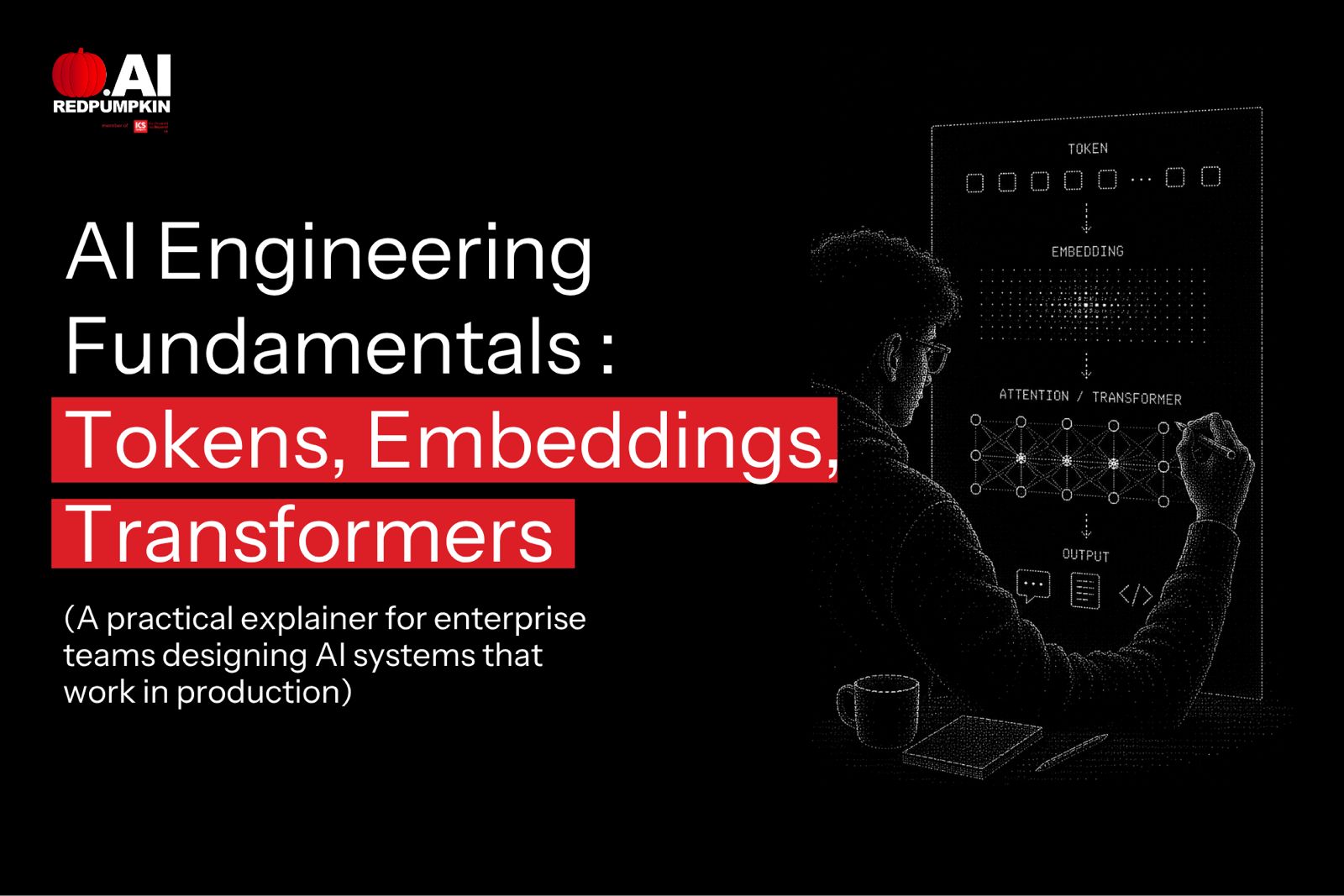
A reliable enterprise AI flow connects the fundamentals in a chain. The user question becomes tokens. Embeddings retrieve relevant source material. The Transformer Architecture connects the question, instructions, and evidence. Sampling shapes the wording. Guardrails and evaluation check whether the answer fits the intended policy, source, and risk level.
A simple production pattern looks like this:
1. Split content into token-aware chunks that preserve meaning.
2. Create embeddings and store them in a vector database.
3. Retrieve and rerank evidence for each user question.
4. Generate the answer with task-appropriate sampling settings.
5. Return citations, confidence signals, and exception flags.
This is the practical layer where AI engineering becomes enterprise engineering. The model gives the system language capability. The architecture gives it accountability.
What CTOs should check before moving from demo to production
Before an AI workflow goes live, CTOs and AI leads should check the fundamentals as operational controls:
· Token budget: Is the prompt carrying only the evidence and instructions needed for the task?
· Retrieval precision: Does the system find the correct source passages for representative questions?
· Embedding strategy: Are chunks, metadata, and filters aligned to the business process?
· Sampling policy: Are temperature and decoding settings documented by use case?
· Evaluation: Are success criteria measured with real examples, failure cases, and reviewer feedback?
· Observability: Are answers, citations, refusals, overrides, and exceptions logged?
The checklist sounds basic. That is the point. Many AI failures come from skipping fundamentals while chasing model upgrades. A stronger model does not repair weak retrieval, unclear prompts, missing evaluation, or sampling settings that change without governance.
What production-ready AI engineering requires
Redpumpkin builds agentic AI solutions that enterprises can run, inspect, and improve after deployment. In practice, that means designing the reliability layer around the model: ingest, validate, guard, observe, and improve. It also means treating tokens, embeddings, attention, Transformers Architecture, and sampling as design variables rather than abstract AI vocabulary.
For Singapore-headquartered and Southeast Asia-focused enterprises, the production question is practical: Will the system work with local data, internal policies, approval workflows, data residency expectations, and human review? The engineering role is to turn model capability into a governed operating system that fits those constraints.
This is why AI engineering fundamentals matter. They give teams a shared language for decisions that otherwise stay hidden inside a model call. Once those decisions are visible, they can be tested, documented, and improved.
FAQ
What is the simplest definition of a token in AI?
A token is a model-readable piece of text. Token count affects cost, latency, context limits, and how much evidence fits inside a request.
Why are embeddings important for enterprise RAG?
Embeddings let a system retrieve information by meaning rather than exact keyword match. They work best when paired with metadata, filtering, reranking, and evaluation.
Is attention the same as reasoning?
Attention weighs relationships between tokens. Reliable enterprise decisions still need grounding, tool use, evaluation, and human review.
What is a Transformer in practical terms?
A Transformer is the architecture behind modern language models. It processes token relationships at scale and uses attention to connect context across a prompt.
How should teams set temperature for production workflows?
Production workflows usually need lower temperature for repeatability and auditability. Higher temperature fits drafting and exploratory tasks where human review is expected.
Do better models remove the need for AI engineering fundamentals?
Better models raise the ceiling. Token budgeting, retrieval quality, prompt structure, sampling policy, evaluation, and observability still decide whether the system performs reliably.
About Redpumpkin.AI
Redpumpkin.AI is a Singapore-headquartered enterprise Agentic AI company with a delivery office in Jakarta. Redpumpkin builds and runs production-ready AI systems for enterprises across Southeast Asia, covering Intelligent Document Processing, Autonomous Analytics & Insights, Enterprise RAG, and Autonomous CX through the Redpumpkin.AI Platform. Its services include Production Readiness Assessment, System Design & Automation, and Managed Production & Optimization.


