

Agentic AI Engineering: Demo Agent vs. Truly Useful Agent
Introduction
Building an agent is easy. Building a useful agent is hard.
This deceptively simple oservation captures the central challenge of agentic AI engineering in 2025 and beyond. The AI industry has reached an inflection point: we can now build agents that look impressive in a five-minute demo, but deploying one that reliably handles real-world complexity over days and weeks remains an unsolved engineering problem.
According to MIT's 2025 State of AI in Business report, only 5% of organizations successfully translate AI agent pilots into measurable business impact (YiZhou, Medium). The remaining 95% fall into the gap between a polished demo and a production system that creates sustained value. Understanding why that gap exists is the first step toward closing it.
The Demo Agent: Impressive but Fragile
A demo agent is typically a conversational LLM wrapper: an API call dressed in a user interface, optimized for short, isolated tasks. It thrives under controlled conditions. You feed ita well-scoped prompt, it generates a clean response, and the audience applauds.This is the 2024-era archetype that dominated investor pitches and conference stages.
These agents work because the environment is clean. The input is curated, the task is bounded, and failure modes are edited out of the recording. As one industry analysis put it, demo-grade setups break under enterprise load, with reports indicating that 90% of legacy agents fail within weeks of deployment because they lack the architectural depth to handle the unpredictable nature of real operations (Nikita S Raj Kapini, Medium).
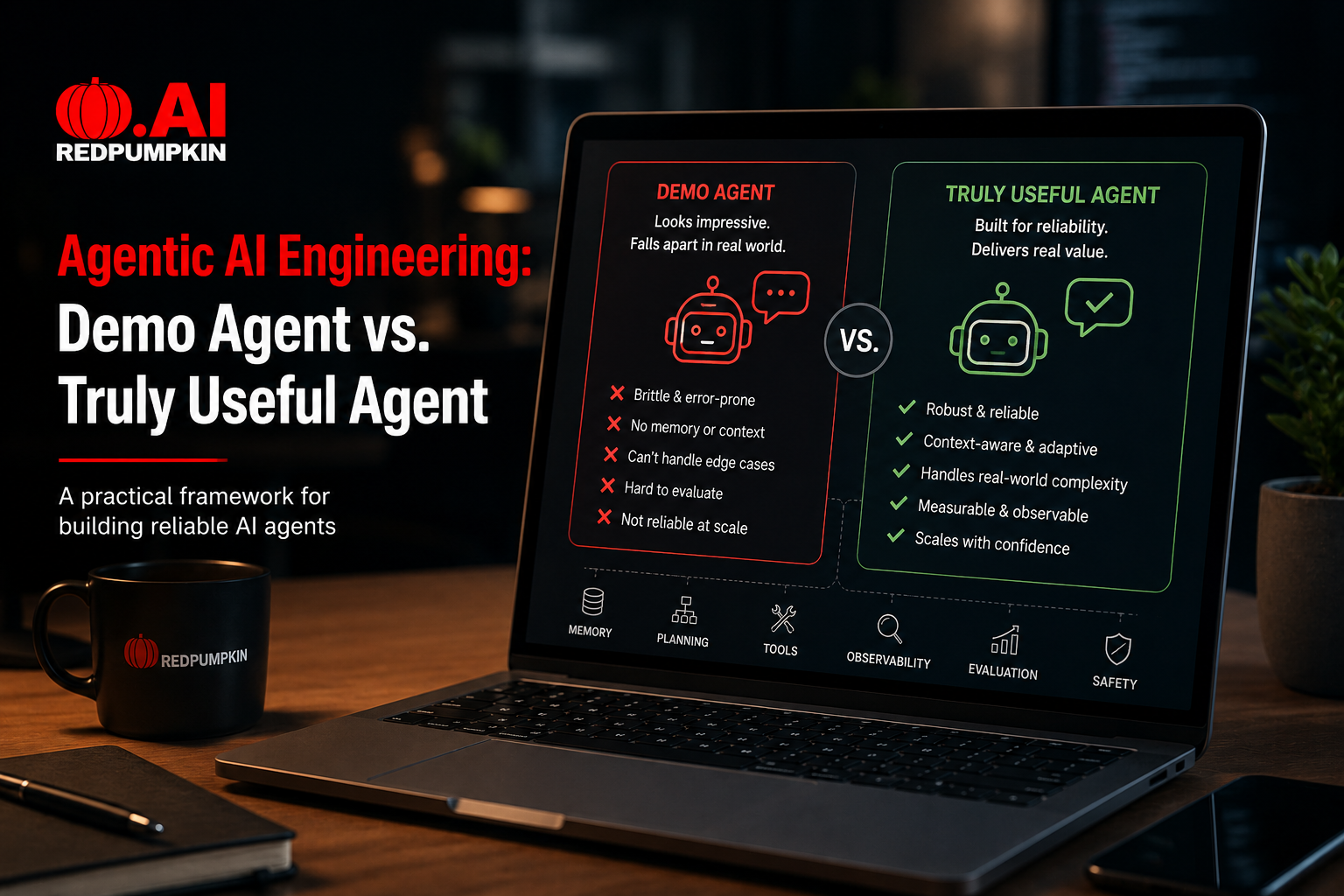
The demo agent pattern has clear characteristics:
• Single-turn optimization: designed to produce one impressive output, not to maintain coherence across a long workflow.
• No persistent state: each interaction starts from scratch, with no memory of prior context or user preferences.
• Brittle error handling: when something goes wrong, the agent hallucinates, loops, or fails silently rather than recovering gracefully.
• Unconstrained scope: the agent attempts anything asked of it, with no guardrails on what it should decline.
None of these are disqualifying for a demo. All of them are disqualifying for production.
The Truly Useful Agent: What Will It Takes?
The useful agent operates at a fundamentally different level of ambition. It targets long-running tasks: acting as a personal assistant, a chief of staff, a project manager, or a deep research analyst. These roles require sustained engagement over hours, days, or weeks, not a single prompt-response cycle.
METR's research on task-completion time horizons demonstrates the scale of this challenge. Their measurements show that the length of tasks frontier models can complete autonomously with 50% reliability has been doubling approximately every seven months. As of early 2026, the best models reached a time horizon of over two full-time-equivalent days (METR, Task-Completion Time Horizons). But the relationship between task duration and failure rate is nonlinear: doubling task duration can quadruple the failure rate.
A truly useful agent must exhibit four qualities:
Precision
The agent must not cause more harm than good. In production contexts, a false positive from an automated assistant can trigger cascading downstream errors. Research on AI agent reliability emphasizes that traditional evaluations miss the operational qualities that matter most: consistency across runs, robustness to perturbations, and bounded failure severity (Towards a Science of AI Agent Reliability, arXiv).
Proactivity
A useful agent understands user context deeply enough to anticipate needs, not merely react to commands. Anthropic's work on context engineering and agent skills, introduced in late 2025 and standardized in 2026, represents one approach: rather than re-deriving context every session, the agent draws on pre-defined skills and accumulated memory to maintain continuity (Augment Code, Agentic Design Patterns).
Predictability
Results must be consistent. Users cannot trust an agent whose output varies wildly between runs. The emerging discipline of agent reliability science proposes formal metrics beyond simple pass rates, including consistency scores and failure severity bounds, to measure whether an agent behaves predictably enough for deployment (Beyond pass@1: A Reliability Framework, arXiv).
Long-term Safety and Reliability
For agents that operate over extended periods, failure modes compound. Error propagation, unbounded loops, and unpredictable latency all emerge not from model capability limitations but from system design choices. Production infrastructure, encompassing logging, monitoring, authentication, rate limiting, and integration with enterprise systems, is where the real engineering challenge lives (Dataiku, Building Production-Ready AI Agents).
Two Classical Software Engineering Problems
Strip away the AI-specific terminology, and the challenge of building useful agents reduces to two problems that software engineers have wrestled with for decades: data storage architecture and system architecture. Getting these things right dramatically changes agent behavior.
Data Storage: Structured vs. Unstructured
Every agent needs memory. The critical design decision is what kind. Structured data (relational databases, typed schemas) provides the rigidity needed for deterministic operations: task tracking, permission management, audit trails. Unstructured data (vector stores, document databases) provides the flexibility needed for semantic search, contextual retrieval, and natural-language reasoning.
Research from Databricks and others on multi-agent systems highlights that the access patterns of agentic systems look less like model training and more like high-concurrency transactional systems operating on unstructured data at massive scale (Scality, Agentic AI Storage Infrastructure). This has direct implications for architecture: agents need fast, consistent reads and writes of session state,memory, and intermediate task context.
The tension between rigid and flexible storage is not a choice of one over the other; it is a design challenge of layering both correctly. A useful agent might use a relational store for its task queue and permission model, a vector database for semantic memory and retrieval, and a key-value store for session state, all coordinated through a coherent data access layer. Getting this layering wrong is a common reason why agents that work in demos fail in production.
System Architecture: How Agents Connect
The second classical problem is how the agent, its sub-agents, skills, tools, and external APIs are composed into a system. Andrew Ng's foundational design patterns for agentic workflows, reflection, tool use, planning, and multi-agent collaboration, provide the conceptual vocabulary, but the engineering challenge is in the implementation details (Andrew Ng on Agentic Design Patterns).
Modern agent architectures have converged on several principles. A planner-worker separation, where a capable model handles strategic planning and cheaper models execute individual steps, can reduce costs by up to 90% while maintaining quality (MLflow, Building Production-Ready AI Agents). Deterministic routing, sending anything with a known correct answer (arithmetic, status lookups, rule-based decisions) to conventional code rather than inference, keeps error rates low and costs predictable.
In multi-agent configurations, architectural choices become even more consequential. Simultaneous read and write operations across shared databases dramatically worsen memory conflicts. Systems must implement strict shared-memory access controls to prevent race conditions, circular dependencies, and cross-agent contamination (Redis, AI AgentArchitecture Patterns). Orchestration protocols like Anthropic's ModelContext Protocol (MCP), OpenAI's Agents SDK, and Google's Agent2Agent (A2A) protocol are converging on interoperable standards, but the architecture chosen within these frameworks determines whether the resulting system is a demo or a product.
Bridging the Gap: From Demo to Production
The path from demo agent to useful agent is not about making the model smarter. It is about building better systems around the model. Based on current research and industry practice, several strategies have emerged as essential:
• Invest in state management. Persistent state across sessions, automatic checkpointing, and graceful recovery from interruptions are table-stakes for long-running agents. Modern frameworks increasingly provide these capabilities as part of the agent harness.
• Build evaluation into the workflow. Embed adversarial verification probes within active agent workflows, not just offline test suites. Store results in audit trails that assess factual grounding and record rationale behind decisions.
• Route deterministic tasks to deterministic code. Not everything needs inference. Arithmetic, lookups, and rule-based decisions should be handled by conventional software, keeping inference reserved for genuinely ambiguous reasoning.
• Design for failure. Assume every step can fail. Build bounded retry logic, circuit breakers, and human-in-the-loop escalation paths. The goal is not to prevent all failures but to contain their blast radius.
• Treat observability as a first-class concern. Production agents require the same logging, monitoring, and alerting infrastructure as any production service. OpenTelemetry integration and structured audit trails are non-negotiable for enterprise deployment.
Conclusion
Enterprise deployment of AI agents is projected to grow eightfold from early 2025 to the end of 2026 (Arcade, State of AI Agents 2026). That growth will expose the gap between demo agents and useful agents at an unprecedented scale. The organizations that succeed will be those that treat agent engineering as a systems problem, not a model problem.
Building an agent is easy. Building one that is precise, proactive, predictable, and reliable enough to trust with real work? That is the engineering challenge of this generation. And the solutions are not exotic; they are the classical disciplines of data architecture and system design, applied to a new class of software.
About Redpumpkin.ai
Redpumpkin.AI exists for AI projects where the hard part is to make AI work reliably inside complex enterprise environments. We help organisations choose, build, and operate the right AI architecture across commercial and open-weight models, multiple cloud environments, and demanding business workflows. Our strength lies in structured evaluation, deep engineering, and production deployment, turning AI ambition into systems that are accurate, governed, scalable, and ready for real work.


